Greatest Formula 1 Drivers of All Time — Ranked by AI (Top 20)
Last updated: August 2025
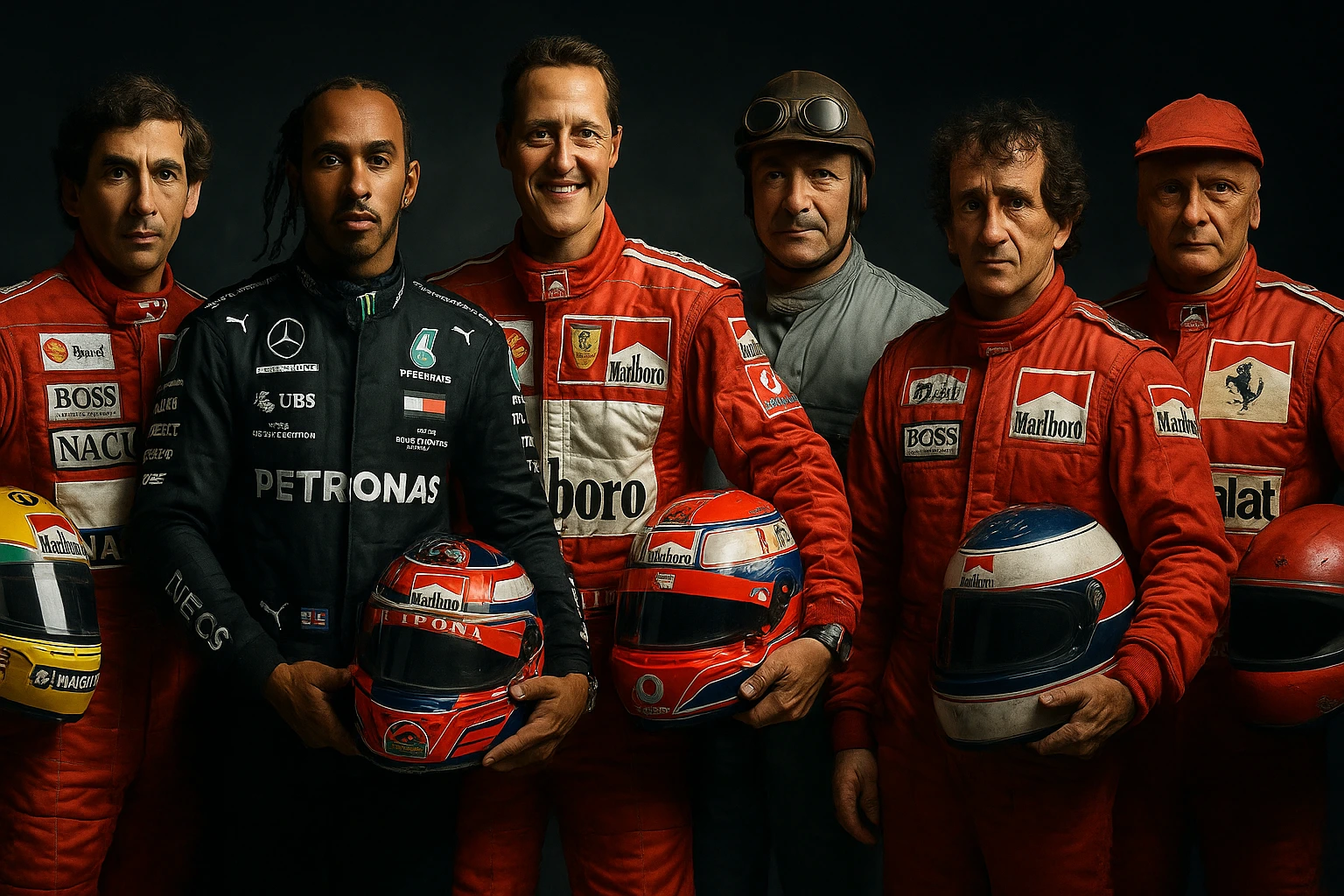
Who are the greatest Formula 1 drivers in history? This AI-powered ranking blends championship totals, peak dominance, adaptability to different cars/eras, racecraft under pressure, technical development input, and cultural legacy. The list goes beyond titles: it evaluates skill translation across decades, statistical dominance, and their impact on the sport’s evolution. Here are the all-time legends who redefined motorsport’s gold standard.
🤖 How This AI Ranking Works
Our AI evaluates drivers using a composite of career achievements, era-relative dominance, adaptability, and influence. Factors include:
- 🏆 Championship Value: Titles adjusted for era length and competitive depth.
- 📈 Peak vs. Longevity: Dominant prime years and sustained competitiveness across decades.
- 🧠 Adaptability: Performance in multiple car regulations, tire eras, and track types.
- 🛠️ Technical Contribution: Feedback and innovation shaping machinery development.
- 🌍 Legacy & Influence: Cultural impact, global reach, and stylistic revolution within F1.
The model normalizes dominance by comparing drivers to their contemporaries, accounting for car performance gaps, safety evolution, and grid depth.
🏆 Top 20 Formula 1 Drivers of All Time — AI’s All-Era Ranking
🇩🇪 1) Michael Schumacher
Seven-time World Champion and Ferrari’s dynasty architect. His relentless fitness, technical feedback, and ruthless consistency created the blueprint for modern dominance. With 91 wins and records that stood for decades, Schumacher redefined preparation and professionalism. Peak Ferrari era (2000–2004) remains one of the most dominant stretches in F1 history.
🇬🇧 2) Lewis Hamilton
Seven titles, over 100 wins, and unmatched qualifying prowess. Hamilton combined blistering speed with tire management and racecraft in all conditions. He conquered hybrid-era dominance with Mercedes while maintaining competitiveness into the 2020s. A cultural icon, his activism and global influence expanded F1’s reach beyond the track.
🇦🇷 3) Juan Manuel Fangio
Five titles in the 1950s, across four different teams, cement his adaptability and mastery. Fangio dominated when reliability was fragile and safety minimal. His win percentage (46%) remains unmatched at the elite level, making him the archetype of era-relative dominance.
🇧🇷 4) Ayrton Senna
The rain master and qualifying genius. Three titles, 65 poles, and a reputation for pushing limits of precision and courage. Senna’s duels with Prost defined the 80s/90s, while his tragic death at Imola 1994 immortalized his legend. His balance of artistry and aggression symbolizes pure driving passion.
🇫🇷 5) Alain Prost
“The Professor” for his cerebral racecraft. Four titles, over 50 wins, and unmatched ability to manage tires, fuel, and pace strategically. Prost’s rivalry with Senna was iconic, but his methodical consistency gave him lasting success across multiple teams.
🇦🇹 6) Niki Lauda
Three-time champion and embodiment of resilience. Survived a life-threatening crash in 1976, returned weeks later, and reclaimed championships in different eras (70s and 80s). His technical mind and leadership later shaped Mercedes’ modern dominance as an executive.
🇬🇧 7) Jackie Stewart
Triple world champion and pioneer for driver safety. Stewart’s smooth style and consistency set new performance standards in the 60s/70s. His advocacy transformed F1 into a safer sport without diminishing its challenge.
🇬🇧 8) Jim Clark
Two-time champion with a natural talent often regarded as the purest ever. His domination in the Lotus, versatility across categories, and win rate in the 60s make him a timeless great. Tragically, his career was cut short in 1968, leaving an aura of unfulfilled greatness.
🇪🇸 9) Fernando Alonso
Two-time champion and endurance master of longevity. Defeated Schumacher at his peak, adapted across V10, V8, and hybrid eras. His tenacity and ability to extract performance from midfield machinery extend his reputation as one of the fiercest competitors in history.
🇳🇱 10) Max Verstappen
Modern juggernaut rewriting records. Multiple championships, unmatched consistency in the Red Bull era, and a ruthless edge in overtaking. His adaptability and relentless pace suggest he could finish among the undisputed all-time top five.
🇧🇷 11) Nelson Piquet
Three-time world champion, known for his technical knowledge and adaptability. Piquet thrived in both turbo and naturally aspirated eras, balancing intelligence with speed. His rivalries with Prost and Mansell defined the 80s landscape.
🇬🇧 12) Stirling Moss
The greatest driver never to win a championship. Moss was consistently competitive across multiple cars and disciplines, embodying versatility and sportsmanship. His influence transcended numbers, shaping F1’s identity in the 50s and 60s.
🇩🇪 13) Sebastian Vettel
Four consecutive titles with Red Bull (2010–13) and over 50 career wins. Vettel’s dominance during the early hybrid-prep era showcased his qualifying mastery and relentless consistency. Later years saw him respected as a mentor and activist for sustainability.
🇫🇮 14) Mika Häkkinen
Two-time world champion and Schumacher’s fiercest rival in the late 90s. Known as “The Flying Finn,” Häkkinen combined calm precision with fearless overtakes, cementing his legacy as a pure racer.
🇫🇮 15) Kimi Räikkönen
The 2007 world champion with Ferrari. Renowned for raw pace, calm demeanor, and adaptability across multiple teams. His longevity and memorable radio moments made him a fan favorite as much as a technical great.
🇬🇧 16) Nigel Mansell
The 1992 champion with Williams. Famous for fearless overtakes and aggressive style, Mansell’s determination produced one of the most dominant seasons in F1 history. He remains a beloved British racing icon.
🇧🇷 17) Emerson Fittipaldi
Two-time champion and the first Brazilian to win the title. His early dominance in the 70s opened doors for South American drivers. Fittipaldi also contributed to the sport’s globalization and later success in IndyCar.
🇬🇧 18) Graham Hill
Two-time F1 world champion and the only driver to complete motorsport’s Triple Crown (Monaco GP, Indy 500, Le Mans). His versatility and charisma made him an enduring figure in motorsport history.
🇦🇹 19) Jochen Rindt
The only posthumous world champion (1970). His speed and commitment defined him as one of the most gifted of his generation. Though his life was tragically cut short, Rindt’s legacy endures in F1 lore.
🇺🇸 20) Mario Andretti
1978 world champion and one of motorsport’s greatest all-rounders. Andretti succeeded in F1, IndyCar, NASCAR, and endurance racing, symbolizing versatility at the highest level. His impact expanded F1’s reach in America.
🧭 Why These 20? Era Context & Translation
Titles are weighed against car advantage, grid depth, and reliability risks. Fangio’s dominance in the 50s is adjusted for small grids, while Hamilton’s hybrid-era run is considered alongside Mercedes’ supremacy. Drivers like Senna, Clark, and Verstappen are evaluated for pure pace and adaptability, proving their skills would translate across eras.
📊 Metrics the AI Weighed Heavily
- 🏆 Win % and Pole %: Era-normalized dominance indicators.
- 🔥 Peak 3-year window: Maximum performance against elite rivals.
- ⏳ Longevity & adaptability: Success across different regulations and decades.
- 🛡️ Two-way racecraft: Pace plus defensive ability under pressure.
- 🛠️ Technical input: Car development influence and feedback.
💬 Honorable Mentions
- Damon Hill: 1996 champion who carried Williams through transition years.
- Jenson Button: 2009 champion, known for smooth driving and adaptability.
- Rosberg Family: Both Keke and Nico Rosberg left distinct championship marks in different eras.
- Jack Brabham: Three-time champion and only driver to win in a self-built car.
📜 Evolution of Driving Styles
From Fangio’s mechanical sympathy to Senna’s qualifying aggression, Schumacher’s fitness revolution, and Verstappen’s data-driven precision — F1 styles evolved with technology. The greatest drivers adapted, proving mastery is not era-bound but rooted in vision, instincts, and adaptability.
🌍 Cultural Legacy Beyond the Track
Senna inspired generations in Brazil; Hamilton globalized F1’s fandom with activism; Schumacher professionalized preparation; Lauda reshaped the sport in and out of the cockpit. These icons transcend sport, influencing safety, culture, and motorsport’s global reach.
🚀 Who Can Enter the All-Time Debate Next?
Lando Norris shows elite consistency in midfield machinery. Charles Leclerc pairs qualifying genius with long-term Ferrari potential. George Russell demonstrates adaptability and resilience at Mercedes. The next decade could redefine the upper tiers of this list.
🧐 Frequently Asked Questions
Is championship count the main factor?
No. Titles matter, but AI balances car advantage, era context, and performance against peers.
Why is Fangio so high despite fewer races?
His era-adjusted win % and adaptability across four teams in five years showcase unmatched dominance.
Can Verstappen surpass Schumacher and Hamilton?
Yes, if his current trajectory continues with sustained dominance and versatility across regulation changes.
Why is Jim Clark revered despite only two titles?
His raw pace and win rate were extraordinary, and his career was tragically cut short.