🔴 Liverpool vs Manchester United: The Definitive Rivalry Guide
Last updated: August 2025
The rivalry between Liverpool and Manchester United is one of the most intense and historic in world football. Born from deep-rooted city pride and decades of on-pitch battles, it has produced unforgettable matches, legendary players and moments that shaped English football. From early 20th-century clashes to modern showdowns watched by millions, this fixture has been a stage for ambition, glory and bragging rights. In this article, we explore its origins, trace its evolution through the decades, revisit classic encounters, highlight the greats who wore each shirt, compare achievements and analyse who holds the upper hand today.
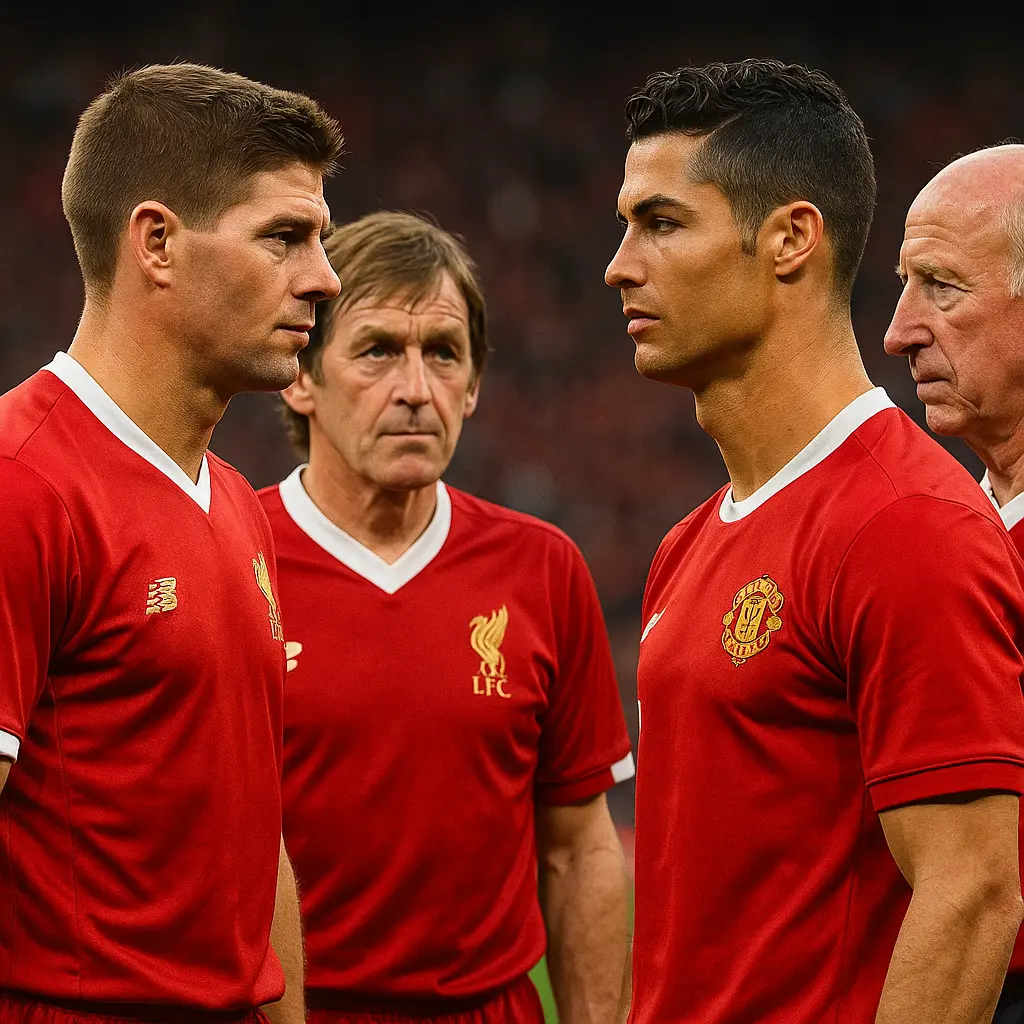
Anfield and Old Trafford, two cathedrals of the game, separated by 30 miles and a century of football conflict.
🗂️ Table of Contents
- 1. Origins: Cities, Canals, Clubs
- 2. Decade-by-Decade Rivalry Timeline
- 3. Head-to-Head: Patterns, Streaks, Iconic Matches
- 4. Trophies & Silverware Comparison
- 5. Liverpool Legends & All-Time Greats
- 6. Manchester United Legends & All-Time Greats
- 7. Managers, Eras & Tactical Identities
- 8. Culture, Fanbases & Global Reach
- 9. Flashpoints & Controversies
- 10. Premier League Era & Modern Dynamics
- 11. Methodology: How the AI Comparison Works
- 12. AI Verdict: Who’s Bigger? Who’s Better (Right Now)?
- 13. FAQ
- 14. Notes on Accuracy & “As of” Dates
🏙️ Origins: Cities, Canals, Clubs — Why It Matters
To understand why Liverpool vs Manchester United resonates so deeply, you must go beyond football. The rivalry is rooted in the industrial history of North-West England. During the 19th century, Liverpool thrived as a port city, while Manchester surged as a manufacturing powerhouse. The opening of the Manchester Ship Canal (1894) enabled cargo ships to bypass Liverpool’s docks, intensifying an economic and civic rivalry that set the stage for sporting conflict. When Liverpool FC (1892) and Manchester United (founded as Newton Heath in 1878, renamed in 1902) ascended the football pyramid, they carried the pride and anxieties of their cities with them.
Early meetings established a competitive baseline, but alternating eras of dominance supercharged the narrative: Liverpool’s European supremacy in the 1970s–80s against United’s domestic hegemony under Sir Alex Ferguson in the 1990s–2000s. Each club’s success became the other’s benchmark—and the other’s goad. The fixture is more than a game; it’s a referendum on identity, heritage and standards.
📜 Decade-by-Decade Rivalry Timeline
1900s–1930s: Foundations & First Impressions
In the first half of the 20th century, both clubs experienced ups and downs, with United winning early league titles and Liverpool building local strength. The rivalry simmered regionally rather than exploding nationally. Transport, media and the structure of English football limited the scope of fan interaction compared with the modern era.
1940s–1950s: Post-War Reconstruction & United’s Busby Era
The post-war period saw Matt Busby shape a bold, youth-focused United. The “Busby Babes” captured the imagination before the Munich air disaster (1958) devastated the club. United’s resilience, rebuilding from tragedy, created a powerful identity story—one that still informs the club’s mythology. Liverpool remained competitive, but this was primarily a United-centred narrative arc.
1960s: Shankly’s Liverpool Rises
Bill Shankly transformed Liverpool’s culture, training standards and expectations. With the famous “Liverpool way” taking root—emphasis on passing, pressing and collective responsibility—the club evolved into a domestic force. The rivalry gained tactical sophistication and bigger stakes, as both clubs eyed titles and European competition.
1970s–1980s: Liverpool’s European Ascendancy
Led by Bob Paisley and later Joe Fagan and Kenny Dalglish, Liverpool became the gold standard of European club football. Multiple European Cups, domestic titles and a conveyor belt of elite talent entrenched the Reds’ reputation for ruthless consistency and continental savvy. United remained a massive club with star power, but Liverpool owned the defining honours of the era.
1990s–2000s: Ferguson’s United Takes Control Domestically
The launch of the Premier League (1992) coincided with Sir Alex Ferguson’s peak years. United built dynasties through squad refresh cycles: the early core around Cantona, the Class of ’92 (Giggs, Scholes, Beckham, Neville brothers) and later waves including Van Nistelrooy, Rooney, Ronaldo, Ferdinand and Vidic. While Liverpool had elite moments and cup successes, United’s domestic dominance tilted the “biggest club” debate heavily toward Old Trafford in this era.
2010s–mid-2020s: Klopp’s Liverpool, New-Look United & a Modern Rebalance
Jürgen Klopp rebooted Liverpool’s competitive edge with a high-pressing, transition-savvy system. European finals, a UEFA Champions League triumph, a long-awaited Premier League title and multiple cups restored the Reds’ elite profile. United, meanwhile, entered a post-Ferguson transition—still a commercial juggernaut with huge global reach, but searching consistently for a tactical identity and long-term stability. The rivalry regained balance: Liverpool surged on-pitch metrics; United sustained unparalleled brand power.
⚔️ Head-to-Head: Patterns, Streaks, Iconic Matches
Because fixtures are ongoing, exact totals evolve season by season. What matters for long-term understanding are the patterns:
- Era-dependent streaks: Liverpool dominated many stretches in the 1970s–80s; United often held the edge from the 1990s to early 2010s; the 2018–2025 window shows stronger Liverpool peaks in key matches.
- Home fortress effect: Anfield and Old Trafford both produce psychological leverage; crowd intensity and tactical setups often differ markedly home vs away.
- Derby dynamics: Form can fly out the window. Underdogs have sprung decisive wins that reshaped title races or top-four battles.
Memorable Clashes
Several fixtures entered folklore—late winners, statement scorelines, cup-tie turnarounds and individual masterclasses. A lopsided Liverpool victory at Anfield in the 2020s punctuated a shift in momentum; on the other hand, United’s late comebacks under Ferguson cemented a generation’s image of Old Trafford as a theatre of clutch moments. These matches become more than statistics; they are identity markers for each fanbase.
League vs Cups
In the league, the rivalry affects title races and Champions League qualification. In domestic cups, knockout volatility can create chaos—rotations, fixture congestion and single-game variance produce dramatic swings. In Europe, meetings have been less frequent, but the prospect of continental showdowns always captivates neutrals due to the clubs’ historic stature.
🏆 Trophies & Silverware Comparison (as of August 2025)
The broad contours are stable: Manchester United hold the record for most English top-flight titles (20), while Liverpool lead in European Cup/UEFA Champions League victories. Cup counts in domestic competitions may fluctuate as seasons add silverware. When weighing achievements, it helps to separate:
- Domestic league titles (First Division/Premier League)
- Domestic cups (FA Cup, League/EFL Cup, Community/Charity Shield)
- Major European titles (European Cup/UEFA Champions League, UEFA Cup/Europa League, Cup Winners’ Cup)
- International club titles (Club World Cup, Intercontinental Cup — historic)
United’s strength: league consistency and an unparalleled haul in the Premier League period under Ferguson. Liverpool’s strength: European pedigree, including multiple European Cups and consistent deep runs in the Champions League in the modern era. This creates a classic domestic vs continental comparison that fuels endless debates.
🌟 Liverpool Legends & All-Time Greats
While lists vary, the following names anchor almost every conversation. Here ficam perfis e traços de jogo:
Kenny Dalglish — The Statesman of Anfield
Visionary forward, technical elegance and decisive in big moments. As player and manager, Dalglish symbolizes what Liverpool demand from their leaders: excellence with empathy. His stewardship through turbulent periods deepened the bond between club and community.
Steven Gerrard — Engine, Drama, Destiny
Box-to-box power, long-range shooting, switch-of-play mastery and elite mentality. The Istanbul 2005 comeback is an immortal set piece in Liverpool lore, placing Gerrard at the centre of perhaps the club’s most dramatic night.
Ian Rush — Ruthless Economy
Clinical finishing, movement between centre-backs and a knack for arriving just ahead of defenders. Rush’s goal records speak to sustained excellence across different iterations of Liverpool sides.
John Barnes — Flair and Function
A winger who could be a playmaker, Barnes fused showmanship with end-product. His blend of dribbling, intelligence and tactical flexibility made him era-defining.
Modern Icons: Mohamed Salah, Virgil van Dijk, Sadio Mané, Roberto Firmino, Alisson
The Klopp era minted new heroes. Salah’s scoring profile reshaped expectations of wide forwards. Van Dijk’s authority stabilized the back line. Mané and Firmino’s off-ball work set pressing standards. Alisson’s sweeper-keeper traits enabled higher defensive lines and quicker transitions.
⚡ Manchester United Legends & All-Time Greats
A balanced list spans Busby to Ferguson e além:
Sir Bobby Charlton — Poise and Purpose
Midfield potency, leadership and grace under pressure. As a Munich survivor and global ambassador, Charlton personified United’s dignity and ambition.
George Best — Genius with Gravity
A Ballon d’Or winger whose improvisation and balance made defenders appear weightless. Best’s charisma shaped United’s cultural aura as much as his footballing impact.
Eric Cantona — Catalyst of a Dynasty
Technique, audacity and authority. Cantona’s arrival accelerated the Ferguson era, elevating standards and seeding a winning habit that became United’s identity.
Class of ’92 & Defensive Bedrock
Ryan Giggs, Paul Scholes, David Beckham, Gary and Phil Neville: a homegrown core synced with elite recruits. Later, the Ferdinand–Vidic axis set benchmarks for aerial dominance and penalty-area command, while Edwin van der Sar (and later David de Gea in his peak years) provided match-swinging shot-stopping.
Cristiano Ronaldo & Wayne Rooney — Power and Evolution
Ronaldo’s transformation into a hyper-efficient wide forward and Rooney’s versatility powered United through a brutal Champions League landscape. Their peaks delivered iconic European nights and relentless domestic output.
🧠 Managers, Eras & Tactical Identities
Rivalries are shaped by managers who leave philosophical fingerprints:
Liverpool: From Shankly to Klopp
- Shankly: Culture architect, pressing principles, collective accountability.
- Paisley: Quiet genius, European pragmatism, player role optimisation.
- Dalglish: Player-manager alchemy, fluid attacking patterns.
- Benítez: Tactical control, compactness, European game-management.
- Klopp: Gegenpressing evolution, verticality, transitional dominance, emotional synergy with fans.
Manchester United: From Busby to Ferguson (and Beyond)
- Busby: Youth-centric bravery, attacking verve, European pioneering.
- Ferguson: Relentless cycle management, squad refresh, psychological edge, set-piece rigor.
- Post-Ferguson: Tactical experimentation, search for identity cohesion, flashes of resurgence mixed with rebuilds.
How Styles Collide
Klopp’s high press vs deep-block counters at United; or, conversely, United’s direct transitions targeting Liverpool’s high line. Derby days magnify micro-decisions: full-back positioning, pivot choices and whether to congest half-spaces to disrupt Liverpool’s diagonals or United’s vertical outlets. Set pieces—corners and wide free-kicks—often swing tight games.
🌍 Culture, Fanbases & Global Reach
“Which club is bigger?” isn’t just a trophies question. United’s global brand scale—broadcast reach, merchandising power and social presence—grew massively in the 1990s–2000s. Liverpool’s worldwide surge in the 2010s–2020s, driven by Klopp-era football and continental success, reshaped the picture. Today, both command huge followings across continents. Universities teach case studies on their commercial strategies; academies from Africa to Asia wear their badges; pre-season tours fill stadiums worldwide.
Cultural identity matters: Liverpool’s “You’ll Never Walk Alone” and the Kop’s choreography form a ritual theatre. United’s “glory, glory” nostalgia intertwines with a legacy of late winners and title parades. For sponsors, both clubs offer storytelling assets that go beyond on-pitch results.
🔥 Flashpoints & Controversies
Fierce rivalries generate contentious moments: heated tackles, touchline confrontations, transfer sagas and disciplinary headlines. These flashpoints—while divisive—sustain the rivalry’s emotional voltage. Curating a neutral timeline of incidents with context helps explain how tension builds between generations.
📺 Premier League Era & Modern Dynamics
In the modern broadcasting era, squad construction aligns with data science, nutrition, travel optimisation and fixture modelling. Liverpool leveraged analytics in recruitment (fit-first profiles, pressing compatibility), while United’s scale provides access to elite talent—though translating budget into coherent systems can be challenging during transitions. From the late 2010s through mid-2020s, Liverpool often excelled on metrics like xG difference and pressing efficiency at their peaks, while United maintained world-leading commercial durability and intermittent cup highs.
Fixture congestion, winter schedules and European travel add variance. Effective rotation—especially at full-back and in the midfield pivot—often correlates with performance in the pivotal Anfield/Old Trafford clashes.
🧮 Methodology: How the AI Comparison Works
We distinguish between “bigger” (structural scale and historical footprint) and “better” (team quality in a time-bounded window). To separate legacy from current form, the model uses two weighted indices:
Club Scale Index (CSI) — “Bigger”
- Domestic league titles (era-adjusted)
- Major cups and European titles (weighted by continental importance)
- Average league position in rolling 10-year windows
- Global reach: broadcast footprint and merchandising signals
- Stadium capacity and matchday potential
- Digital audience trajectory and engagement
- Historical continuity at top-flight level
Performance Quality Index (PQI) — “Better Right Now”
- Recent points per game (last 2–3 seasons, league)
- Non-penalty xG difference per 90 vs top-half teams
- Defensive field tilt, high turnovers created, PPDA proxies
- Squad health: minutes lost to injury, age curves, depth
- Managerial stability and tactical adaptability
- Strength of schedule and travel (Europe + domestic cups)
We also incorporate era normalisation to avoid penalising older dynasties for lacking modern sports science. Outputs include confidence intervals that we translate into plain-language qualifiers.
⚖️ AI Verdict: Who’s Bigger? Who’s Better (as of August 2025)?
Who’s Bigger?
Manchester United retain a slender but persistent lead on the Club Scale Index thanks to the record number of English top-flight titles and a historically unmatched commercial footprint that exploded during the global Premier League expansion. Stadium capacity and the legacy of multi-era domestic dominance keep the needle tilted their way in this dimension.
Who’s Better Right Now?
The Performance Quality Index across the late-2010s to mid-2020s shows Liverpool with a strong case in contemporary, on-pitch terms during their best seasons: higher pressing efficacy, superior xG-difference against top-half opponents and a clearer tactical identity under a coherent recruitment philosophy. Even with squad refresh cycles, Liverpool’s structure has recently produced more consistent elite-level performances in peak years.
❓ FAQ
Is Liverpool vs Manchester United the biggest rivalry in English football?
In terms of combined trophies, global attention and historical depth, it’s arguably the biggest. Regional derbies have different textures, but Liverpool–United is uniquely national and international in scope.
Which club has more league titles?
Manchester United hold the record for most English top-flight titles.
Which club has more European Cups/Champions Leagues?
Liverpool lead in European Cup/UEFA Champions League triumphs.
Who are the greatest players in each club’s history?
Typical Liverpool shortlists include Dalglish, Gerrard, Rush, Barnes and modern icons like Salah and Van Dijk; United shortlists include Charlton, Best, Cantona, the Class of ’92 and modern icons such as Ronaldo and Rooney.
What’s the fairest way to compare the clubs?
Separate long-term scale (titles, global reach, decades-long dominance) from current quality (form, xG, pressing data, squad health). Time-boxing avoids mixing legacies with recent form.
📝 Notes on Accuracy, Freshness & How to Use This Guide
Because both clubs continue to add matches and trophies, numbers evolve. This guide is stamped “Last updated: August 2025” to give temporal context. When replicating tables, always attach an “as of” date and separate competitions (league, FA Cup, EFL Cup, European titles, international club titles) for transparency.
Journalists, bloggers and researchers can use this narrative framework and then plug in exact season-by-season numbers from official competition records.
🔗 Related Reading & Internal Navigation
Enjoy deep, data-aware football analysis? Explore more at Bueon.com. Consider bookmarking this page to reference the rivalry’s historical context whenever future fixtures shift the debate.