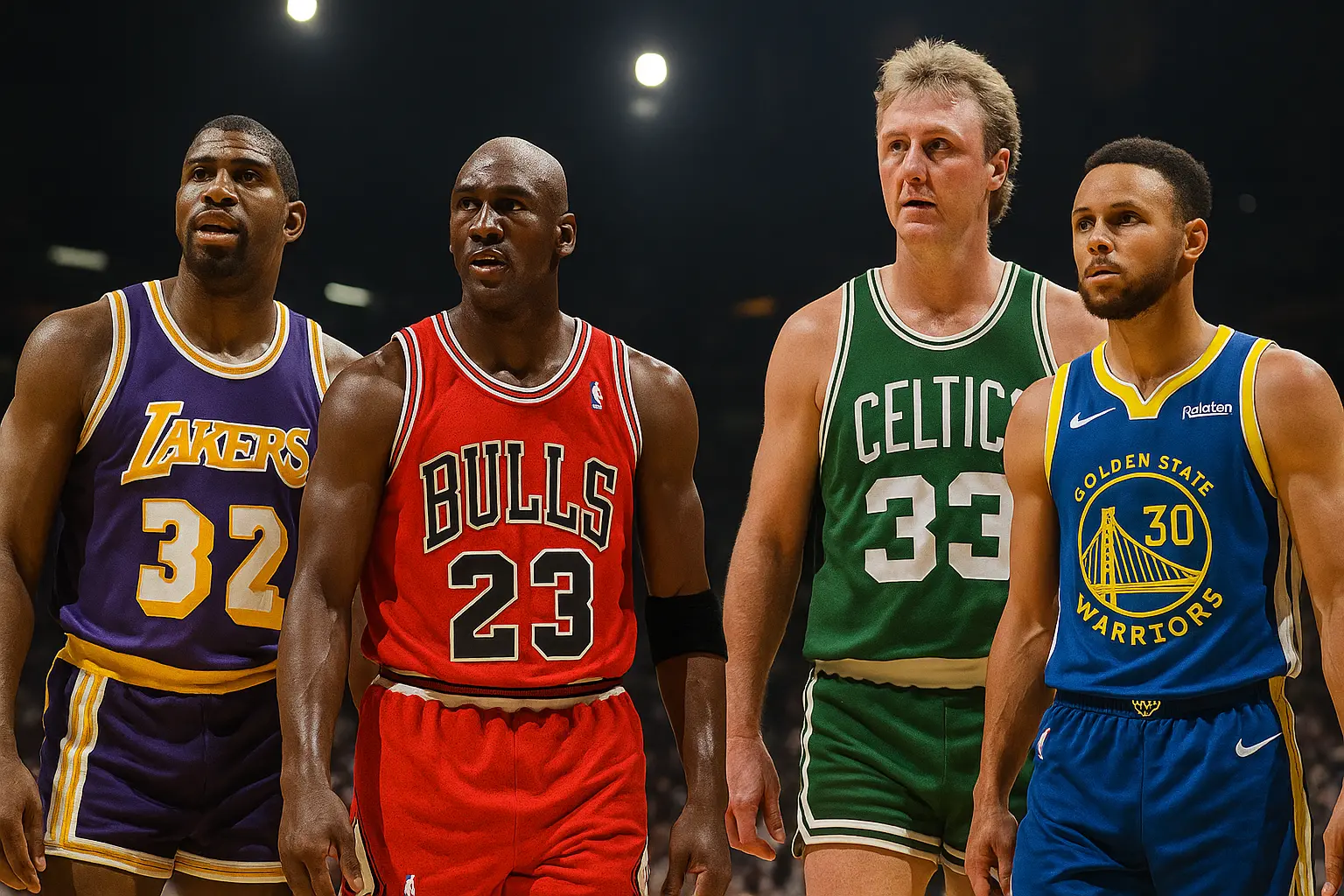
NBA GOAT List (2026): Top 20 Greatest NBA Players of All Time
Who is the greatest NBA player of all time? This 2026 NBA GOAT list ranks the top 20 players ever, including Michael Jordan, LeBron James, and Kareem Abdul-Jabbar, based on championships, stats, longevity, peak dominance, and overall impact.
This AI-powered ranking combines advanced analytics (BPM, PER, WS, TS%, EPM) with era-adjusted context, playoff translation, cultural influence, and skill portability to build a more complete all-time NBA ranking.
The AI’s top 5 are Michael Jordan, LeBron James, Kareem Abdul-Jabbar, Bill Russell, and Magic Johnson.
- Peak and playoff value
- Longevity and consistency
- Era-adjusted context
- Legacy and influence
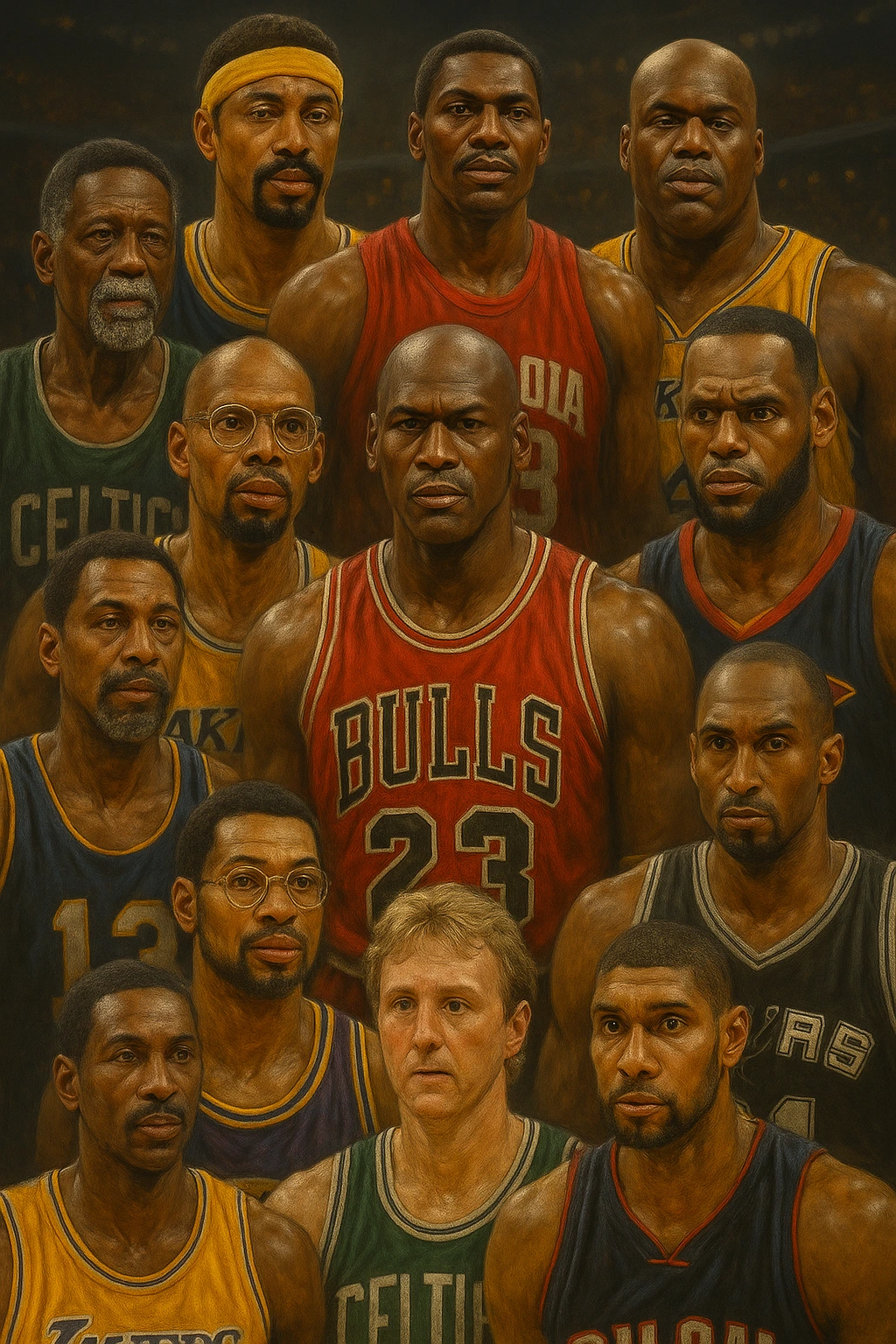
Editorial note: This ranking was created with AI-assisted analysis and reviewed by the Bueon Editorial Team before publication.
What changed in this update: player order, methodology notes, future candidates and structured data were refreshed on April 30, 2026.
How to read it: it is an analytical ranking, not an official NBA list. The goal is to compare peak, longevity, playoffs, two-way value, era context and cultural impact in one framework.
How This AI Ranking Works
The model scores players using a composite of peak performance, longevity, playoff dominance, championship value, individual accolades, era-relative impact, and skill portability (shooting, defense, playmaking). Advanced metrics considered include Box Plus/Minus (BPM), Player Efficiency Rating (PER), Win Shares (WS), True Shooting % (TS%), and Estimated Plus/Minus (EPM), alongside context such as pace, rules, spacing, and competition depth. Public statistical references are cross-checked against league and basketball-reference databases before editorial review.
- Playoff & Finals value: Production vs elite defenses, adaptability, elimination-game resilience.
- Peak vs longevity: Prime dominance matters, but so does stacking elite seasons.
- Scalability: Ability to thrive with different teammates, coaches and systems.
- Two-way impact: Elite defense and playmaking separate the truly generational.
- Legacy & influence: Style revolutions, global reach, cultural footprint.
Important note: this list is era-adjusted. The goal is to measure how dominant players were relative to peers, while acknowledging differences in training, spacing and strategy across decades.
Top 20 Ranking Table (Quick Scan)
Prefer a fast view? Here’s the AI’s full Top 20 in a table before the detailed breakdowns.
| Rank | Player | Primary Value | Era / Archetype |
|---|---|---|---|
| 1 | Michael Jordan | Peak + playoff scoring + elite defense | 90s wing GOAT |
| 2 | LeBron James | All-around engine + longevity | Modern heliocentric forward |
| 3 | Kareem Abdul-Jabbar | Two-way big + longevity + skyhook | 70s/80s center anchor |
| 4 | Bill Russell | Defense + winning equity | 60s dynasty backbone |
| 5 | Magic Johnson | Playmaking + offense orchestration | 80s jumbo PG |
| 6 | Shaquille O’Neal | Unmatched interior dominance | 2000s power center |
| 7 | Tim Duncan | Two-way consistency + titles | System-proof big |
| 8 | Larry Bird | Shooting + IQ + clutch | 80s elite wing |
| 9 | Wilt Chamberlain | Statistical dominance + athletic outlier | 60s/early 70s super-center |
| 10 | Stephen Curry | Gravity + efficiency + revolution | Modern spacing engine |
| 11 | Hakeem Olajuwon | Elite two-way center skills | 90s defensive apex |
| 12 | Kobe Bryant | Tough-shot making + winning résumé | 2000s wing icon |
| 13 | Kevin Durant | Portable elite scoring | Modern unicorn scorer |
| 14 | Giannis Antetokounmpo | Two-way dominance | Modern transition force |
| 15 | Jerry West | Two-way guard value + clutch | 60s/70s elite guard |
| 16 | Oscar Robertson | Creator prototype | 60s heliocentric guard |
| 17 | Dirk Nowitzki | Spacing big + 2011 run | Stretch-big pioneer |
| 18 | Kevin Garnett | Defense ecosystem + versatility | Modern switchable big |
| 19 | Moses Malone | Rebounding + interior scoring | 80s power center |
| 20 | Dwyane Wade | Two-way slashing + Finals peak | 2000s elite guard |
Top 20 Greatest NBA Players of All Time — AI Breakdown
1 Michael Jordan
The all-time benchmark. Jordan pairs the greatest postseason scoring profile with elite perimeter defense: six championships in six Finals, five MVPs, 10 scoring titles, and a defensive résumé that includes a Defensive Player of the Year and nine All-Defense selections. His half-court shot creation, off-ball movement, and relentless on-ball pressure translate cleanly across eras—making him the gold standard for a title-winning #1 option. Beyond the court, Jordan helped globalize the NBA and defined the modern superstar brand.
2 LeBron James
The most complete all-around engine in NBA history across a 20+ year timeline. LeBron’s blend of size, processing speed, rim pressure, and elite playmaking created championship-level offenses in multiple systems and across multiple franchises. His longevity is unprecedented for a primary creator, and his playoff résumé includes sustained dominance against elite competition. If Jordan represents the highest peak, LeBron’s argument is the widest base of elite seasons.
3 Kareem Abdul-Jabbar
The ultimate longevity big with an unanswerable signature weapon: the skyhook. Kareem’s six MVPs remain the record, and his two-way value stretched from the early 1970s into the late 1980s. He anchored elite teams in different contexts—first as the Bucks’ dominant centerpiece, then as the Lakers’ championship pillar alongside multiple stars.
4 Bill Russell
The greatest defensive winner ever. Russell’s 11 championships in 13 seasons reflect defensive supremacy, leadership, and game-breaking rim protection. His impact often outstrips box-score totals because he shaped possessions—stopping shots, controlling outcomes, and igniting transition offense. In an era where defense was the foundation of dynasties, Russell was the foundation of the greatest one.
5 Magic Johnson
The greatest offensive conductor and arguably the best transition playmaker ever. Magic’s 6’9” size and vision turned pace into a weapon, elevated teammates across roles, and produced elite postseason translation. His peak value is strongly tied to creation: he didn’t just rack up assists—he engineered efficient shots at scale.
6 Shaquille O’Neal
Peak Shaq is the most physically overwhelming force the league has seen: rim pressure, touch, footwork, and passing out of doubles. His 2000–2002 run (three straight Finals MVPs) represents an apex where defenses were structurally distorted by his presence. In a neutral-era model, interior dominance of that magnitude remains extremely difficult to match.
7 Tim Duncan
The model of two-way consistency and championship scalability. Duncan combined rim protection, elite positioning, and reliable scoring while enabling multiple Spurs eras to contend for nearly two decades. His value is “system-proof”: insert him into any context and you get elite defense, elite decision-making, and winning equity.
8 Larry Bird
A shooting and decision-making supercomputer. Bird’s three straight MVPs underscore his peak, while his off-ball skill, passing, and clutch shot-making translate perfectly to modern spacing. He was not only productive—he was a strategic advantage who punished any coverage with the right read.
9 Wilt Chamberlain
The most extreme statistical outlier ever, with era-adjusted dominance that still breaks models. Wilt’s profile is sometimes misunderstood because his early volume scoring overshadows the later years where he leaned into defense, rebounding, and playmaking. When optimized for team value, he proved he could anchor elite outcomes.
10 Stephen Curry
The greatest shooter ever and the central engine of the three-point spacing revolution. Curry’s off-ball gravity creates efficient offense even when he doesn’t touch the ball, converting average lineups into elite units. Championship-level impact, unprecedented shooting, and portability across lineups keep him comfortably in the all-time top tier.
11 Hakeem Olajuwon
A rare center who combines elite footwork scoring with championship-level defense. Hakeem’s rim protection, switching agility, and playoff performance make him one of the most era-agnostic superstars ever. In modern defensive schemes that value mobility, his profile becomes even more valuable.
12 Kobe Bryant
A five-time champion defined by high-difficulty shot creation, postseason resilience, and a complete competitive package. Kobe’s prime included All-Defense caliber impact and an offensive arsenal that scaled in both “1A” and “co-star” roles. His cultural legacy is among the largest in basketball history.
13 Kevin Durant
A 7-foot elite shooter with guard skills: one of the most portable superstars ever. Durant’s efficiency at high volume, plus his ability to score in any scheme, makes him a universal plug-in offensive engine. Injuries affected continuity, but prime KD remains an all-time scoring ceiling.
14 Giannis Antetokounmpo
A modern two-way colossus with MVP-level offense and DPOY-level defense. Giannis’s transition pressure and rim finishing create elite efficiency, while his defensive range anchors championship systems. Continued skill growth (passing, midrange, free throws) strengthens his all-time trajectory.
15 Jerry West
The “Logo” was a two-way star whose era-adjusted efficiency and playoff production remain elite. His Finals MVP in a losing effort reflects how dominant he was under pressure. West’s overall value is a blend of scoring, defense, and late-game reliability.
16 Oscar Robertson
The original do-everything lead creator. Oscar’s combination of strength, vision, and scoring versatility set the blueprint for heliocentric engines. Era context matters, but his archetype translates cleanly to modern spacing and pace.
17 Dirk Nowitzki
The stretch-big pioneer with one of the greatest title runs ever (2011). Dirk’s shooting gravity and shot-making unlocked modern spacing concepts before they became league defaults. His longevity and franchise leadership add substantial career value.
18 Kevin Garnett
A defensive ecosystem: communication, mobility, rim deterrence, and switchable coverage in one player. Offensively, he added passing, screening, and reliable scoring. His impact often exceeded team context, and modern schemes amplify his versatility.
19 Moses Malone
An all-time rebounder whose offensive rebounding created extra possessions at scale. Three MVPs and a dominant 1983 title run highlight a profile built on physicality and efficiency around the rim. His portability next to other stars is a key reason he remains top 20.
20 Dwyane Wade
A two-way slashing guard with a Finals peak that ranks among the most dominant. Wade combined rim pressure, defensive playmaking, and clutch creation. Injuries reduced total prime volume, but his championship equity and two-way impact keep him in the top 20.
Why These 20? Era Context & Translation
This list is not a simple rings leaderboard or points leaderboard. The model balances peak impact and career value, then compares dominance relative to era peers. For earlier decades, pace and role context are adjusted; for modern eras, spacing, three-point volume, and defensive rule environments are considered.
- Era normalization: pace, efficiency and opponent quality adjusted toward a neutral baseline.
- Portability: value as a primary option and as a scalable co-star matters.
- Skill flexibility: shooting, switching defense, playmaking reads, screening and rim deterrence translate best.
Metrics the AI Weighted Heavily
- Playoff impact: performance against elite defenses and scheme adaptability.
- Peak 3-year window: “best player alive” seasons carry outsized weight.
- Longevity & availability: stacking elite seasons matters, not just one hot run.
- Two-way value: defense + offense integration (not just scoring totals).
- Efficiency at volume: TS% with high usage is prioritized over empty calories.
- Portability & fit: value in different lineups and teammate contexts.
Honorable Mentions (Just Outside the Top 20)
- Kawhi Leonard: two Finals MVPs and elite two-way peak; injuries reduce total volume.
- Chris Paul: consistent team elevation and elite creation; title equity impacted by health/variance.
- Nikola Jokić: all-time offensive hub; continued longevity and titles could push him rapidly upward.
- Charles Barkley: MVP-level peak with elite efficiency; ringless but historically impactful.
- Karl Malone: enormous longevity; postseason and context debates keep him just outside.
- John Stockton: orchestration + defense + longevity; lower usage caps peak volume.
- Scottie Pippen: elite defense and #2 value; smaller #1 offensive peak than top-20 locks.
- Allen Iverson: iconic cultural impact; efficiency and era translation are the swing factors.
- Steve Nash: offense-driver MVP; defense and playoff translation reduce top-20 certainty.
- Elgin Baylor / Julius Erving: pioneering wings with major historical influence.
Who Can Enter the Top 20 Next?
Nikola Jokić is tracking as a historically rare offensive hub; sustained MVP-level play and more titles could move him into the Top 10 conversation. Luka Dončić has early-career creation volume; defense, conditioning and postseason outcomes will determine his ceiling. Victor Wembanyama has unprecedented defensive tools; health and offensive development could redefine the center value curve. Jayson Tatum / Anthony Edwards are on superstar arcs where playoff résumé will write their final rank.
Sources and Editorial Standards
Bueon uses a transparent editorial process for evergreen sports rankings: AI-assisted clustering, human review, statistical cross-checking and periodic updates when player résumés change.
- NBA.com Stats — official box score, player and team statistical context.
- Basketball Reference — historical awards, leaders, seasons, playoffs and advanced metrics.
- Basketball Reference Leaders — career leaderboards used for longevity and era checks.
- NBA History — league history, awards, championships and official historical context.
Rankings are revisited after major NBA milestones, MVP-level seasons, title runs, retirements or historical-stat corrections.
Frequently Asked Questions
How does the AI rank the greatest NBA players of all time?
It blends peak performance, longevity, playoff translation, championships, awards, era-adjusted context and advanced analytics like BPM, PER, WS, TS% and EPM.
Is ring count the most important factor?
No. Rings matter, but the model weighs context: role, competition strength, and the player’s direct influence on winning—especially in the playoffs.
Why is Curry ranked so high?
Curry’s off-ball gravity and shooting range changed defensive geometry and created a spacing revolution. His efficiency and portability are historically elite.
How are different eras compared fairly?
The model normalizes for pace, league efficiency, rules and role expectations, then compares dominance relative to contemporaries.
Could Jokić break into the Top 10 soon?
Yes—continued MVP-level play plus additional championships and durability could move him rapidly upward.
Enjoy deep, data-driven basketball analysis?
Explore more premium sports content, AI rankings, and clean analytical breakdowns across basketball history.
Explore more AI-powered insights at Bueon.com